The VBS Job Nobody Assigns and Everybody Regrets Skipping
Most VBS chaos comes from one invisible role nobody assigns until it's too late. Here's the operational fix that kept my station leaders in front of their kids all week, and the tradeoff I still haven't fully solved.
Megan Whitaker
Ministry Operations Specialist, PopLesson · July 23, 2026
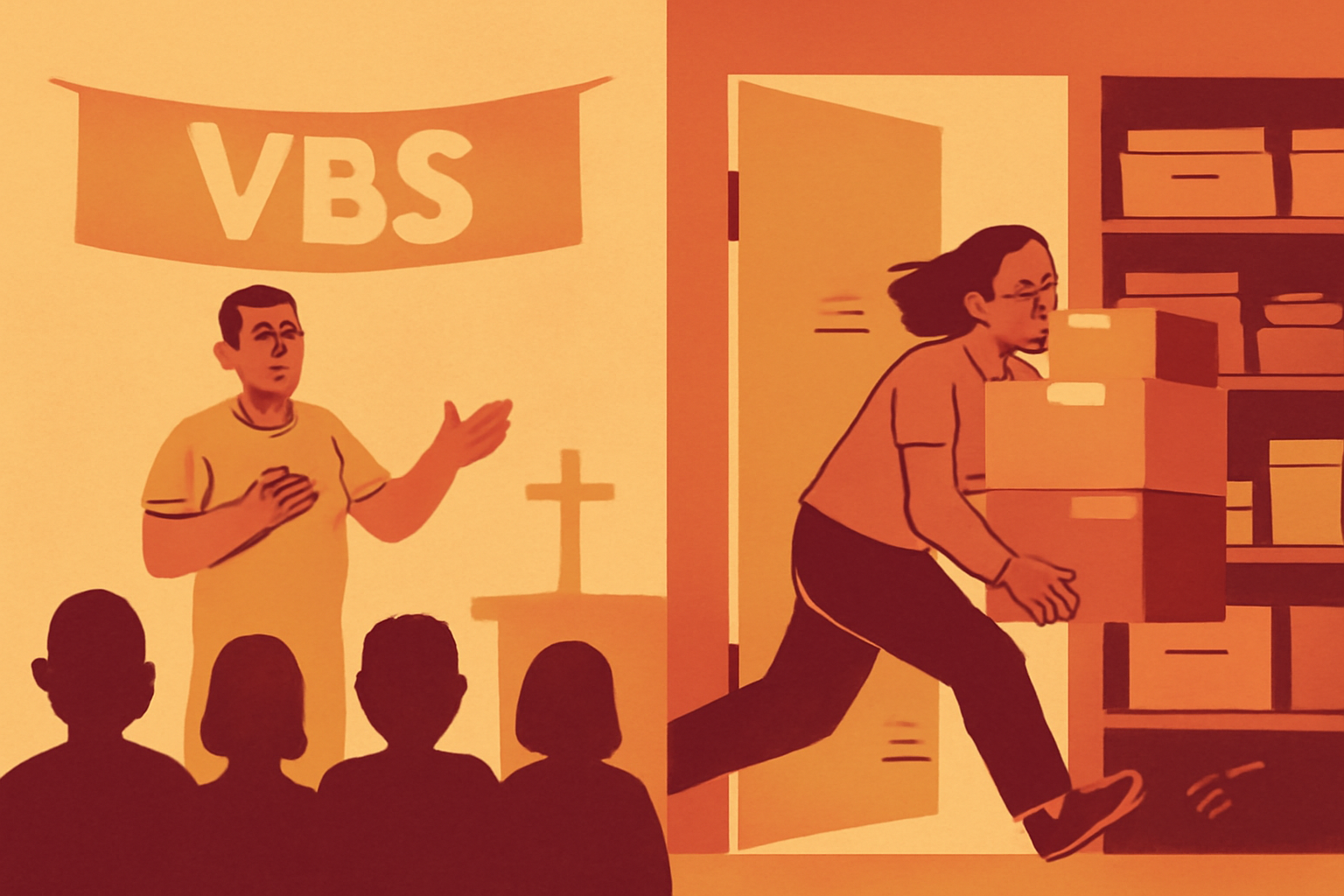
Every VBS week has a person who ends up sprinting to the supply closet forty times a day, and nobody planned for that person to exist. That's the failure I want to talk about. Not the curriculum. Not the volunteer shortage everyone complains about in June. The invisible role that swallows one adult whole and then gets blamed for the chaos it was quietly absorbing.
In the eight years I spent running children's ministry at a growing suburban church, the single most predictable meltdown was Tuesday morning of VBS. Monday runs on adrenaline. Everyone's fresh, the coffee's hot, the crafts are pre-cut because someone had time the week before. Tuesday is when the missing glue sticks show up. Or don't.
I started calling this the runner problem. Somebody, usually the most competent person in the building, becomes the human patch for every gap in the plan. Out of cotton balls in the preschool room? Runner. Snack allergy nobody flagged? Runner. Registration table has a kid whose name isn't in the system and a parent who's now late for work? Runner.
Here's what I got wrong for years. I thought the answer was better prep. More detailed vacation Bible school lesson plans, tighter supply lists, a color-coded binder that would anticipate every need. And prep matters, don't get me wrong. But the binder never accounted for the fact that a real VBS week generates problems no lesson plan can predict, and those problems all flow to one unlucky person because nobody was formally assigned to catch them.
So I assigned it.
The year I finally made "Runner" an official volunteer role with a name tag and a written job description, the whole week changed. Not because the problems went away. They didn't. A five-day VBS with 120 kids and 25 volunteers is going to throw you fifteen surprises a day, minimum, and that's a slow year. What changed was that the surprises had a designated owner who wasn't also trying to lead a station or manage a classroom.
The runner job description was almost embarrassingly simple. Stay mobile. Carry a walkie or keep your phone on. Know where everything is stored. Have a small float budget (we used a $75 gift card to the craft store two blocks away) so you're not tracking down the director for petty cash while a room full of second graders waits. Check the preschool rooms first every morning because they run out of things fastest and complain about it least.
What I didn't expect was how much this protected the station leaders. When your craft leader has to abandon her table to hunt for pipe cleaners, she doesn't just lose four minutes. She loses the room. Twelve kids with scissors and no adult attention regroup into something feral by the time she gets back. The runner role isn't really about supplies. It's about keeping the people who teach in front of the kids they're teaching.
I'll be honest about the part I still haven't solved. The runner role only works if you pick the right person, and the right person is almost always someone you'd rather use as a teacher. They're calm, they know the building, they don't panic. Those are exactly the traits that make a good lead volunteer. So every year you're making a trade: you're spending one of your strongest people on a job that looks, from the outside, like they're just walking around. I've had co-directors question it. I've had a volunteer feel demoted by it, which I handled badly the first time and better the second. I don't have a clean fix for that tension. You just have to name it out loud and explain why the walking-around job is load-bearing.
This is also where church size changes everything. A small church running VBS for 30 kids with 8 volunteers probably doesn't need a dedicated runner. The director is the runner, and that's fine at that scale. The role becomes essential somewhere around 60 to 70 kids, in my experience, or the moment you're operating in more than one hallway. Once your rooms are far enough apart that a supply run takes three minutes each way, you've already lost a teacher for the duration whether you planned to or not.
One more thing I learned the hard way. Document where things are stored before the week starts, not because you'll forget, but because the runner isn't always you. The year my runner got a stomach bug on Wednesday, I needed to hand the walkie to a substitute who had no idea the extra name tags lived in the third drawer of the choir room, not the supply closet. A one-page storage map taped inside the closet door would have saved me twenty minutes I did not have.
Most VBS burnout isn't spiritual and it isn't about the theme or the music or whether the lessons landed. It's operational. It's one person absorbing every unowned task until they're too fried to enjoy the thing they spent four months building. Give that job a name. Give it a budget. Give it to someone strong and then tell everyone why. The week won't run perfectly. Nothing with 120 kids runs perfectly. But your teachers will still be standing on Friday.
Megan Whitaker
Ministry Operations Specialist, PopLesson
Build your next curriculum with ForgeAI
Describe your topic, your group, and your goals. PopLesson builds a complete lesson series. Free to build, $3 to download.