The Snack Table Is the Most Honest Part of VBS
Most VBS plans obsess over content and ignore the transitions between stations, which is exactly where the week falls apart. The snack table is the most honest test of whether your timing and volunteer coverage actually hold up.
Rachel Donovan
Curriculum Specialist, PopLesson · July 2, 2026
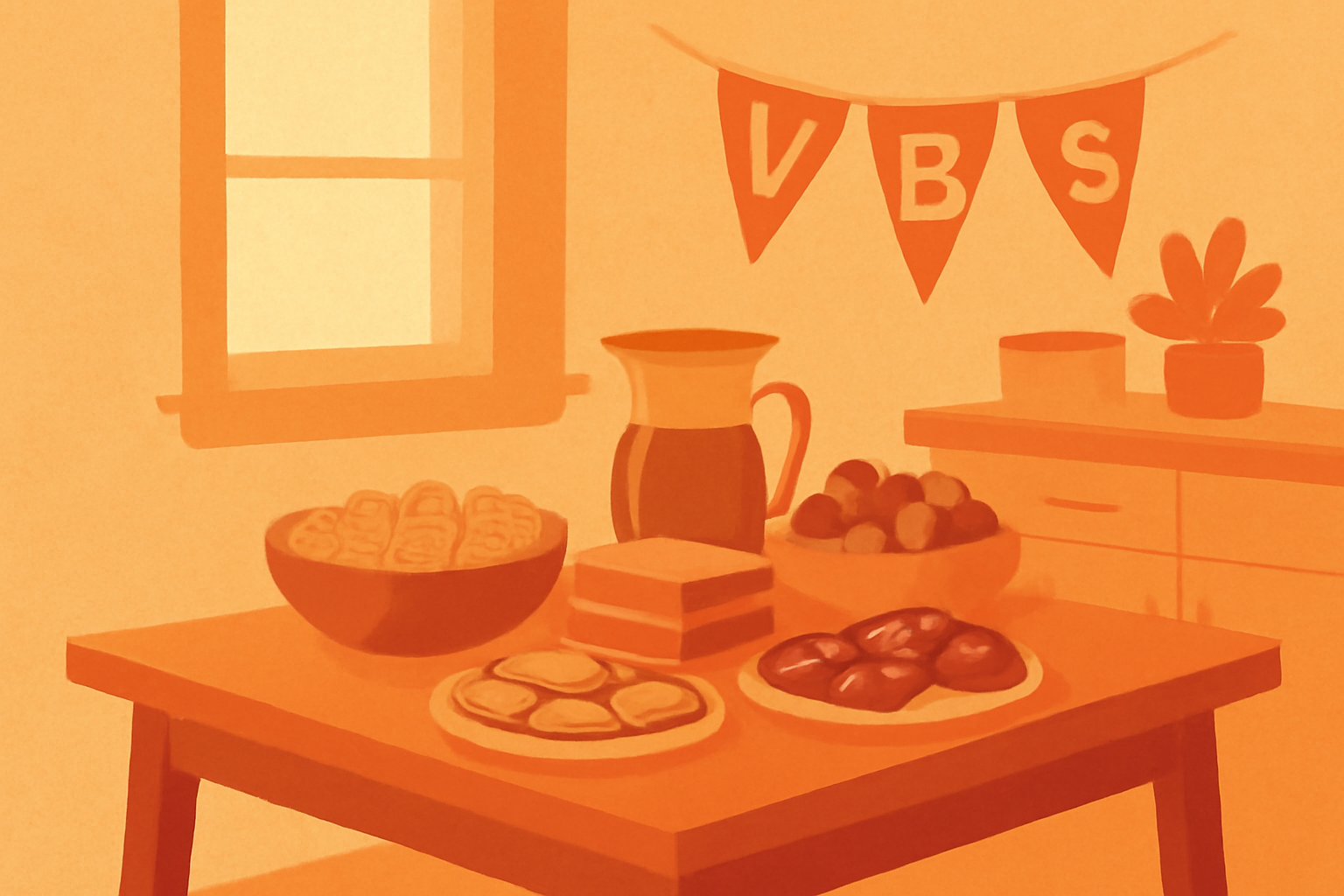
Nobody wants to hear this in June, but the best predictor of whether your VBS week holds together isn't your theme, your decorations, or how good your opening skit is. It's whether the snack rotation makes sense.
I know how that sounds. Petty. Logistical. Beneath the actual mission of the week. But I've watched more VBS weeks unravel over transitions and timing than over anything spiritual, and the snack table is where the whole thing shows its real face.
If the schedule doesn't work, the lesson doesn't happen. It doesn't matter how good the lesson was on paper.
Here's what I mean. Most vacation Bible school lesson plans are built around content. Day one is creation, day two is the fall, day three is redemption, and so on. That's fine. Content sequencing is the part publishers are good at. But content isn't what breaks. Movement breaks. The forty seconds between stations where forty kids are supposed to walk quietly to the next room and instead one of them finds a loose ceiling tile string and now you've lost the group.
I spent a chunk of one VBS week at a mid-size suburban church just standing at the hinge points. Not teaching. Watching. The teaching stations were solid. The crafts were fine. What was falling apart was the two minutes nobody planned for, when a group of second graders arrived at snack four minutes early because the music station ran short, and there was no snack ready, and no adult sure of whose job it was to have it ready.
Total chaos. Over crackers.
Design the seams, not just the sessions.
That's the thing I wish somebody had told me eleven years ago when I was first surviving these weeks. You will spend hours polishing the lesson and almost no time on the ninety seconds between lessons, and the ninety seconds is where you lose them. A kid who checks out in the hallway does not magically re-engage when they sit down in the next room. They walk in already gone.
So when I look at a week's plan now, the first thing I check isn't the Bible content. It's the transition map. How does a group physically get from station A to station B? Who owns that group during the walk? Is the receiving station ready before the group arrives, or are we asking children to wait in a doorway, which no child on earth has ever done well?
And the snack table, specifically, is the honest one because it's the only station with zero content to hide behind. In a teaching station you can improvise. A good storyteller can stretch or compress. Crafts can absorb extra minutes because kids will happily glue things for as long as you let them. But snack is binary. Either the food is out and portioned and the allergy list is taped to the wall and someone is standing there, or it isn't. There's no faking snack. When snack falls apart, it's because your volunteer coverage and your timing were already weak, and this is just the first place it became visible.
I'll be honest about something I got wrong for years. I used to think the fix was tighter scheduling. More precise minute counts. I'd build a schedule down to the five-minute block and hand it to volunteers like that would save us. It didn't. Volunteers don't run on stopwatches, and kids definitely don't. The schedule would survive until about ten fifteen on Monday and then reality took over.
What actually helped was building slack into the seams on purpose and assigning ownership of the slack. Not "the schedule says snack is at 10:30" but "Karen owns the pre-K snack station and it is set up by 10:15 no matter what the rest of the week is doing." Ownership beats timing. A person who knows a thing is theirs will make it work even when the schedule falls behind. A schedule with no owner just becomes a document nobody follows by Tuesday.
Does this scale to every church? Not cleanly. A little rural VBS with one combined group of fifteen kids barely has transitions at all. You could run that whole week off a single sheet of paper and never think about seam design, because there are almost no seams. This whole obsession is really for the churches running multiple age groups through a station rotation, which is where the movement math gets ugly fast. The more groups you have cycling, the more the transitions become the actual event.
I don't have a perfect formula for how much slack to build in. I've seen five minutes be plenty and I've seen five minutes evaporate. It depends on your building, your ages, your volunteer experience, how far apart the rooms are. What I'm sure of is that the seam is where the week lives or dies, and almost every plan I've ever seen ignores it.
So before you polish opening day, walk your building the way a seven-year-old would walk it. Find the doorways where groups will pile up. Find the station that will always run short. Find the snack table and ask, cold, who has this on Wednesday when two of your volunteers called in sick. If you can't answer that, no theme is going to save you.
Rachel Donovan
Curriculum Specialist, PopLesson
Build your next curriculum with ForgeAI
Describe your topic, your group, and your goals. PopLesson builds a complete lesson series. Free to build, $3 to download.