The Repetition Problem Nobody Warns You About When You Teach the Bible at Home
Home-based Bible teaching exposes a design flaw most curriculum hides: retention doesn't come from re-reading a story, it comes from making learners retrieve it after a gap. Here's what cognitive science says to change about how you plan a week at the kitchen table.
Daniel Ashford
Learning Design Lead, PopLesson · July 12, 2026
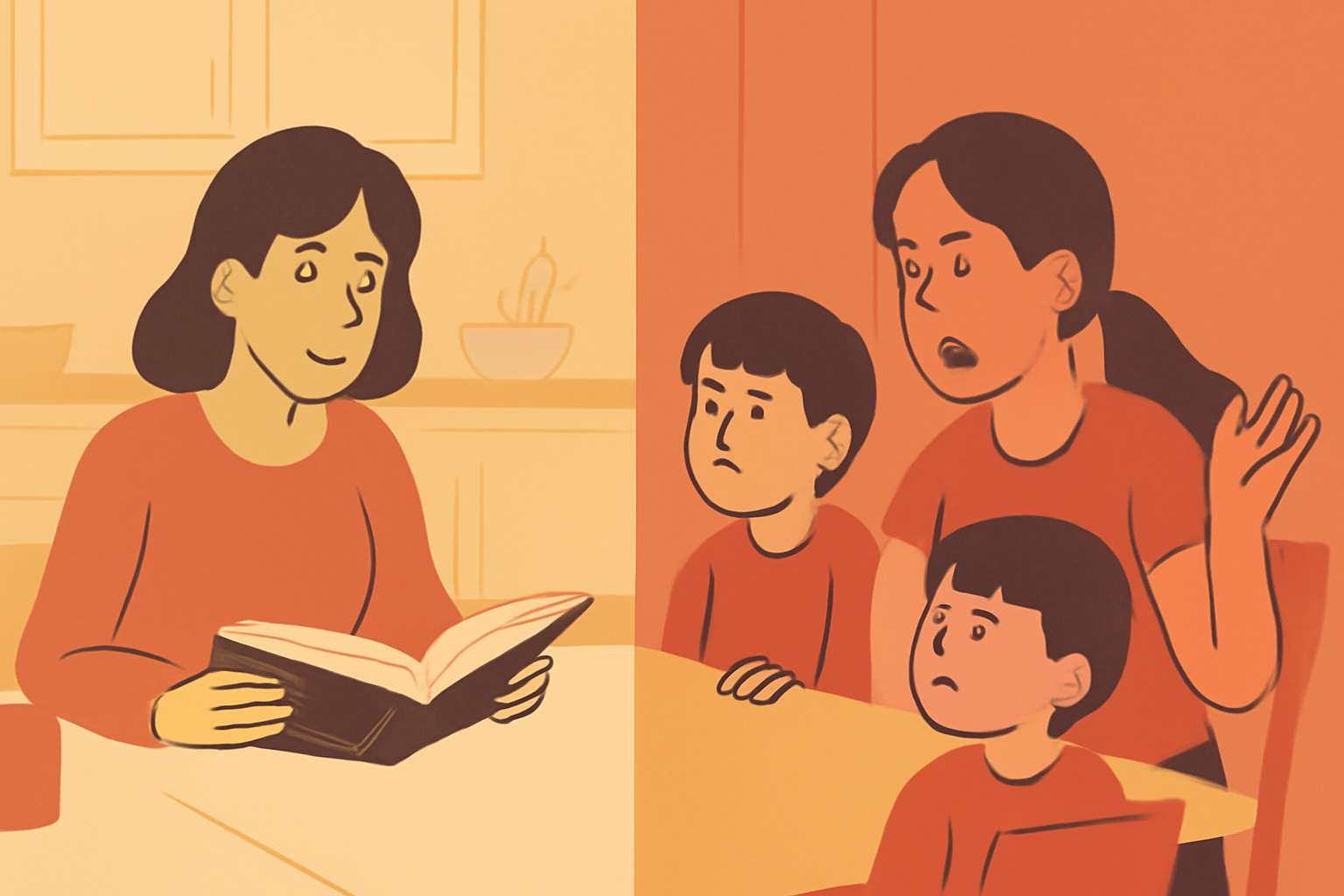
A parent teaching Genesis to two kids at the kitchen table has a problem she doesn't know she has. Her kids remember everything. Not in the way she hopes. They remember that they already did the Joseph story, and they will tell her so, loudly, the second she opens the book again.
This is the thing about home-based faith teaching that almost nobody designs for. In a Sunday school room, a teacher gets a kid for maybe 40 minutes a week and rotates through a class of eight or ten. Repetition hides inside the gaps. A kid forgets, the class churns, the material gets a natural refresh cycle. At home, with the same two or three learners every single day, there is nowhere for weak lesson structure to hide. You feel the seams immediately.
I spent five years building curriculum for church and non-profit education programs before this, and the single most common design failure I saw in home-oriented material was treating retention like it happens through exposure. Show the kid the story enough times and it sticks. That is not how memory works, and it is not how it has ever worked.
Why exposure is not the same as encoding
Cognitive science has been pretty settled on this for a long time. Rereading and re-hearing content produces something called fluency, which feels like learning. The material gets easier to process each time, so your brain reports back: yep, I know this. But ease of processing and durable memory are different systems. A kid can sit through the David and Goliath story four times, feel completely familiar with it, and retain almost nothing they could actually use or connect to anything else.
What actually drives retention is retrieval. Making the learner pull the information out, not pushing it back in. This is the finding behind the whole body of research on the testing effect, and it is wildly underused in faith settings because "testing" sounds cold and clinical and nobody wants to quiz their eight-year-old on Scripture like it's a spelling list.
So don't quiz. Ask. There's a difference, and it's the difference between a good home Bible lesson and a boring one.
Here's what I mean in practice. Most homeschool Bible curriculum I've reviewed structures a lesson as: read the passage, explain the passage, ask three comprehension questions, do a craft. The comprehension questions come right after the reading, which means the kid is retrieving from working memory. That's fluency again. Easy, useless. The retrieval that builds memory happens when there's a gap. Ask about Joseph's brothers on Tuesday when you taught Joseph on Friday. Ask it cold, at breakfast, with no book open. That awkward pause while the kid digs for it? That's the actual learning happening. The discomfort is the mechanism.
What this changes about how you plan a week
The design decision here is small and it costs almost nothing, which is why I keep pushing it.
Stop front-loading all your questions into the lesson itself. Distribute them. A single week of home teaching should look less like five self-contained lessons and more like one story taught once, then retrieved four times across the following two weeks in shrinking, unpredictable moments.
A few things worth being honest about:
- It feels less productive.
- Parents and home educators consistently tell me the interleaved approach feels wrong in the moment, because a good retrieval session is often three minutes long and produces a lot of "I don't remember," and it's genuinely hard to sit in that silence and trust that the struggle is doing the work when everything in your instinct says to just reopen the book and reread it to them so everyone feels better.
- The evidence on spacing intervals for young kids specifically is thinner than I'd like. Most of the strong retrieval and spacing research was run on older students and adults. I'm extrapolating downward, and I want to be straight about that. For a six-year-old, I genuinely don't know the optimal gap, and anyone who tells you they do with precision is guessing.
What I'm confident about is the direction. More retrieval, less rereading. More gaps, less cramming. That holds across basically every age group anyone has studied it on.
One caveat that matters: this whole approach assumes you're teaching a continuous group over months, which is exactly the home situation and almost never the drop-in Sunday one. If you're a Sunday school teacher seeing rotating kids, you can't build spaced retrieval across weeks because you don't control the weeks. Different constraint, different design. Don't take home-teaching mechanics and force them onto a room you see once.
The kitchen table is actually the ideal environment for how memory really works. Same learners, long timeline, total control over when you ask the question. Most home material just doesn't use any of that. It builds Sunday school lessons and ships them to living rooms, comprehension questions stapled to the end, craft included, retention left entirely to chance.
Teach the story once. Then spend the next two weeks making them find it again.
Daniel Ashford
Learning Design Lead, PopLesson
Free lesson plans you might like
Build your next curriculum with ForgeAI
Describe your topic, your group, and your goals. PopLesson builds a complete lesson series. Free to build, $3 to download.